A volunteer role: clarify responsibilities before promising regular hours
A cause can matter to you while a particular volunteer assignment is a poor fit. Compare the role’s actual responsibilities, support and time requirements before promising a recurring commitment. The aim is a useful arrangement for both volunteer and organization, without assuming that age determines ability or that service must produce a medical benefit to be worthwhile.
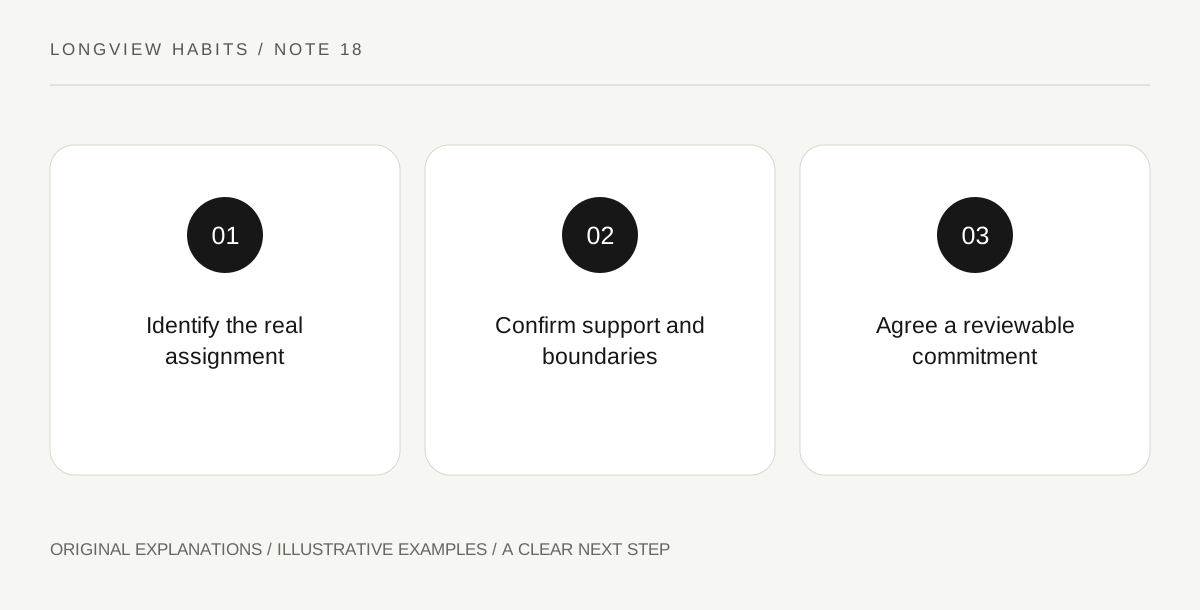
Original explanatory diagram. Read the full method and limitations below.
Use the program description as an inquiry route
AmeriCorps Seniors RSVP describes opportunities that match volunteers’ skills, interests and schedules with community organizations. Use that as an example of role matching, not a guarantee that a local assignment is currently available or personally suitable. Identify the actual organization and contact for the role. Ask what the work includes and what it excludes. A broad cause such as helping neighbors can conceal very different tasks, responsibilities and conditions that should be clear before a commitment is made.
Turn the role into three concrete questions
Ask what the volunteer does during an ordinary session, who provides training or supervision and what happens when help is needed. Keep clinical, legal or other specialist tasks within the organization’s confirmed qualified arrangements. A willingness to serve does not establish competence for every assignment. Describe your own experience honestly, including what you do not want to undertake. This protects the usefulness of the match instead of making the first conversation a performance of unlimited availability.
Confirm practical limits without apology
Discuss transport, access needs, scheduling and any costs or checks through the actual program process. This article supplies no eligibility or reimbursement promise. Agree how a session is canceled or a commitment changed when circumstances require it. Do not assume that a flexible advertisement means every local role has no fixed responsibility. A bounded commitment can be more reliable than an ambitious promise made before the person knows how the task fits everyday life.
Review contribution and fit separately from health
After an agreed introduction, ask whether the role used the desired skills and whether the support was as described. The organization’s needs and the volunteer’s preferences both matter. A mismatch can justify a different assignment without becoming a judgment about usefulness or age. Keep any claimed health benefits outside the personal review; this article guarantees none. Service can have value because it contributes to a chosen cause, with clear responsibilities and a sustainable arrangement.
Illustrative everyday example
Illustrative inquiry: an adult interested in local history asks a volunteer coordinator about a cataloging role. They confirm the actual task, training, supervision and cancellation process before offering regular hours. A physically demanding additional task is not silently included. After an introduction, both sides review the match. The volunteer makes no eligibility assumption and does not treat participation as a prescribed health intervention.
Questions that come up
Does a program description guarantee a suitable local opening?
No. Confirm the actual opportunity, current requirements and support with the responsible organization.
Is declining one task inconsistent with volunteering?
No. Clear scope helps create a reliable match. A willingness to contribute does not require accepting every responsibility offered.
References and scope
These sources support the factual background. Examples and exercises are original illustrative teaching material. References do not imply endorsement.
- AmeriCorps: AmeriCorps Seniors RSVP — Matching volunteer opportunities with skills, interests and schedules; no eligibility, local availability, reimbursement or health-outcome promise.