A respite handoff: agree responsibilities before the caregiver’s break begins
A caregiver’s break is easier to arrange when the person providing relief knows the actual agreed role. Build a handoff around the person receiving care, the support provider’s confirmed scope and the responsible contacts. The aim is a clear temporary arrangement, without assuming that willingness to help automatically supplies clinical training or permission for every task.
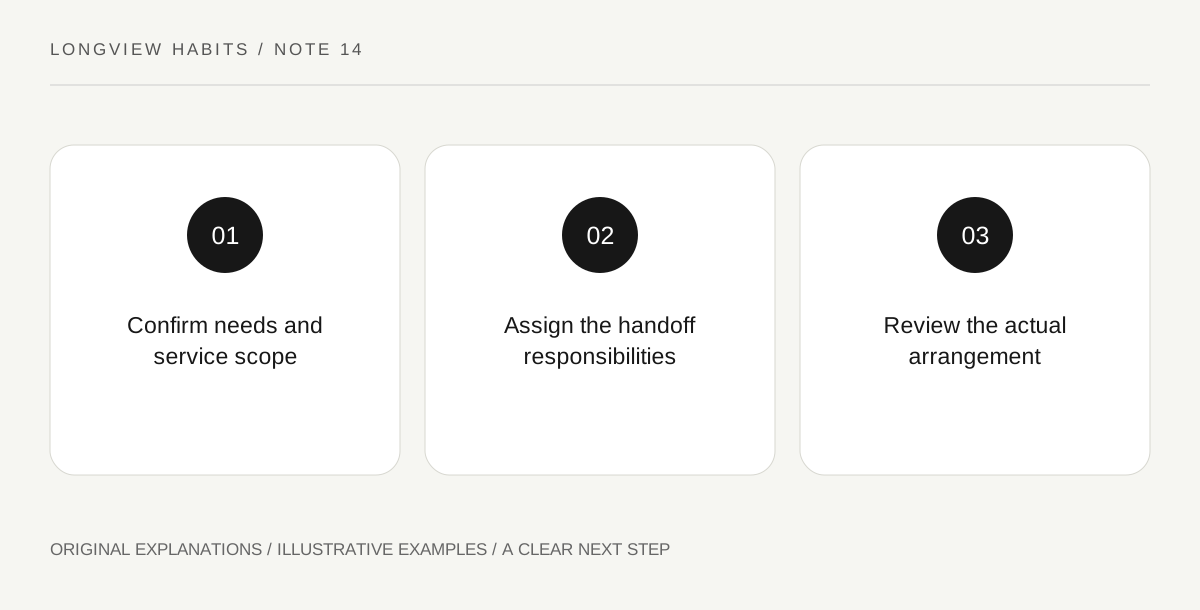
Original explanatory diagram. Read the full method and limitations below.
Name the arrangement before filling the schedule
NIA describes respite care as short-term relief for primary caregivers and notes that it can take different forms and settings. That is the broad service context, not a guarantee that a particular provider can meet every need. Begin with the care recipient’s preferences and the actual service being considered. Ask what support is available, what assessment is required and which responsibilities the provider can accept. A friend’s offer and a professional service should not be treated as identical merely because both create time away for a caregiver.
Write a role-specific handoff
Use the provider’s process to identify agreed daily support, relevant preferences and contact arrangements. Keep clinical instructions in their authoritative form and share them only through the appropriate authorized route. This article supplies no medicine administration, transfer, feeding or emergency procedure. If a needed task falls outside the person’s confirmed skills or role, resolve the gap with the responsible service before the break begins. Do not leave a blank beside a critical task and assume someone will improvise.
Confirm the beginning and end
Record when responsibility starts, who is present and how the handoff is acknowledged. Confirm the ending arrangement separately, including what happens if the caregiver is delayed. These are coordination questions, not a promise that one universal buffer makes every service workable. Ask how changes or concerns are reported and which contact is appropriate. The care recipient should understand the arrangement in a usable format as far as possible, rather than discovering an unfamiliar plan after everyone else has agreed it.
Review what the arrangement actually achieved
Afterward, ask the care recipient and provider what worked and what needs clarification next time. Keep ordinary preferences separate from a health concern requiring professional attention. A caregiver does not need to justify a break by making the handoff perfect or returning with a dramatic improvement. The useful outcome is a temporary support arrangement that was understood and appropriately staffed. Preserve the practical learning while leaving costs, clinical suitability and future service availability to the actual responsible sources.
Illustrative everyday example
Illustrative handoff: a caregiver arranges a confirmed respite service and records the start, end and responsible contact. One requested task is outside the provider’s stated scope, so it is resolved before the break rather than assigned informally to a willing neighbor. The care recipient’s preferences are included. The follow-up note records a communication improvement without changing clinical instructions or promising future coverage.
Questions that come up
Does being willing to help establish competence for every care task?
No. Match the actual tasks to the provider’s confirmed scope and qualifications, resolving gaps with the responsible service.
Does this guide establish respite coverage or cost?
No. NIA’s broad service description is not a personal coverage decision. Ask the actual provider and relevant payer about your situation.
References and scope
These sources support the factual background. Examples and exercises are original illustrative teaching material. References do not imply endorsement.
- NIA: What Is Respite Care? — Respite as short-term caregiver relief in varied settings; no coverage promise, clinical task instruction or provider-suitability determination.