A telehealth rehearsal: separate technical help from the health conversation
A remote appointment can become frustrating when the person helping with technology also takes over the conversation. Prepare the two roles separately. A short rehearsal can establish how the patient joins, hears and speaks, while leaving the clinical discussion centered on their concerns and the provider’s actual instructions rather than the helper’s assumptions.
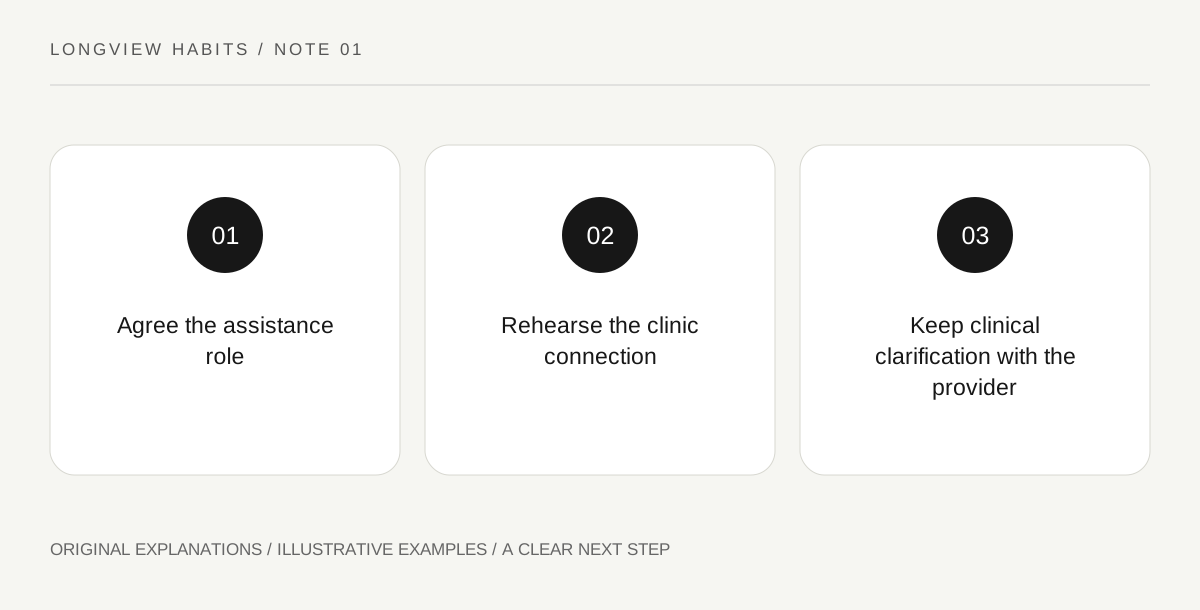
Original explanatory diagram. Read the full method and limitations below.
Define the helper’s job in advance
NIA’s telehealth guidance recommends preparing and testing devices, sound and video before an appointment. Use that narrow practical foundation to agree what assistance is wanted. The patient might ask someone to help connect, then leave, or remain with permission for a specified purpose. Write that arrangement clearly. Being good with a device does not automatically authorize someone to hear private information, answer personal questions or make health decisions on another adult’s behalf.
Rehearse the actual joining process
Use the clinic’s current instructions and approved test process if available. Check that the patient can find the appointment link, hear ordinary speech and position the device without holding it throughout the conversation. Use no medical measurements or symptom assessment during a practice call. Avoid posting an appointment link or personal information in a public support forum. Record a technical contact and the clinic’s stated fallback arrangement rather than improvising a different platform at the scheduled time.
Keep the concern list reachable
Place the patient’s own short question list where it can be read without repeatedly leaving the screen. Ask whether paper, larger text or another familiar format works best. Do not convert the list into a script the patient must recite perfectly. Its purpose is to preserve their priorities when a technical interruption occurs. If the provider decides an in-person assessment is needed, treat that as a care decision rather than a failed performance by the patient or the device.
Review the arrangement after the visit
Ask which part of the setup helped and which created a barrier. Keep technical changes separate from clinical follow-up, so an audio problem does not become an excuse to guess an instruction. Unclear care directions should go back to the clinic. Update only the practical rehearsal note for next time. A successful remote visit is not defined by the helper doing everything smoothly; it is defined by the patient having an appropriate opportunity to communicate within the provider’s actual service.
Illustrative everyday example
Illustrative rehearsal: an adult asks a relative to help open the clinic’s test connection, then remain outside the room unless requested. A paper question list sits beside the screen. When an instruction is missed during the visit, the patient asks the clinic to clarify rather than relying on the relative’s guess. The next rehearsal note changes device placement, not the care plan.
Questions that come up
Does technical help imply permission to join the whole appointment?
No. Agree the adult’s preferences and follow the clinic’s process for anyone participating. Technical skill and permission to hear a health discussion are separate matters.
Should a rehearsal determine whether remote care is medically sufficient?
No. The provider determines the appropriate care format. The rehearsal concerns access to the service, not a clinical suitability assessment.
References and scope
These sources support the factual background. Examples and exercises are original illustrative teaching material. References do not imply endorsement.
- NIA: Telehealth, What Is It, How to Prepare, Is It Covered? — Practical preparation and advance testing of telehealth devices/audio/video; no coverage, clinical suitability or consent-law claim.