Family health history: add a dated change instead of rebuilding the whole tree
A family health history can become outdated because updating it feels like a large genealogy project. Use a small dated change note when relevant information becomes available. The purpose is to give a clinician accurate context with uncertainty preserved, without diagnosing relatives, inferring an inherited condition or asking a family member to disclose more than they want to share.
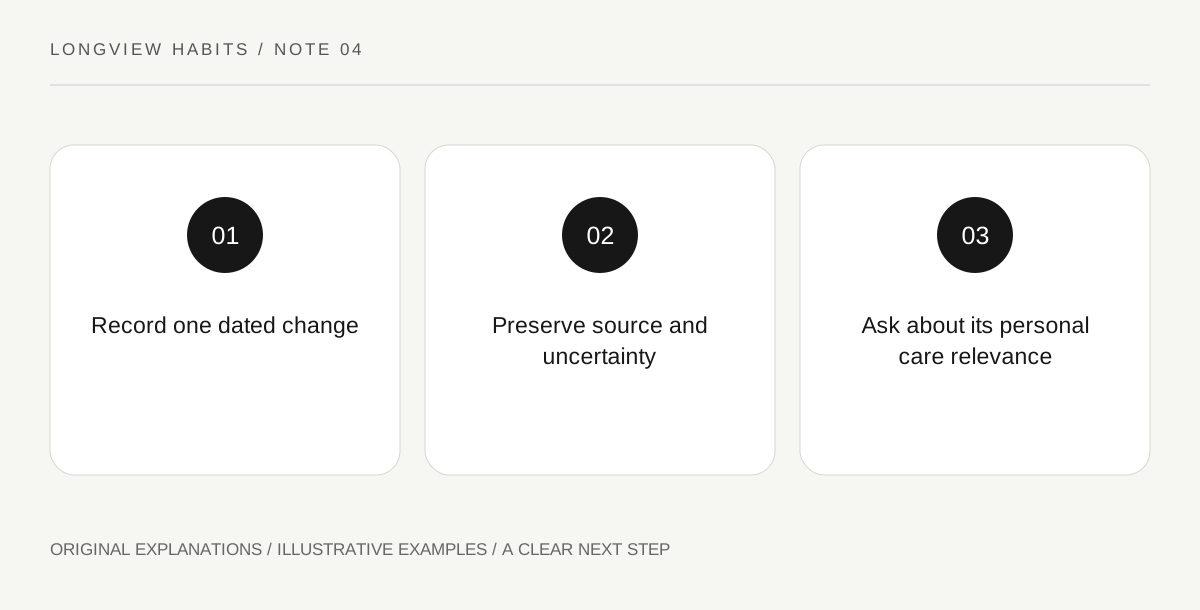
Original explanatory diagram. Read the full method and limitations below.
Keep health history separate from a family story collection
CDC explains that family health history can inform a discussion about risk and appropriate preventive care. That does not make a family pattern a personal diagnosis. Start with the information you already have and identify one update: a newly confirmed condition, corrected relationship or clarified age where known. Use the relative’s own information with permission. Do not turn a rumor, social-media post or remembered symptom into a confirmed diagnosis merely to make the record look complete.
Give every entry a confidence and date
Create fields for relationship, reported condition, approximate age if known, information source and date learned. Use unknown or reported but unconfirmed where appropriate. An approximate age should remain approximate. Keep a correction alongside the reason for changing the record rather than silently replacing uncertain information with a confident-looking entry. The format helps a clinician distinguish a documented family detail from a recollection. It does not calculate risk or establish which tests any individual should receive.
Share only what serves the care conversation
Store the note privately and bring the relevant information to the health professional through the normal process. Avoid circulating a full family file to everyone because one person requested an update. The person who supplied information may have preferences about how it is shared. If a relative declines to discuss a condition, preserve the gap rather than pressuring them for a complete chart. A useful record can contain unknowns and still support a more specific conversation than a broad statement that illness runs in the family.
Ask what the update changes for you
At the appointment, explain the new information and ask whether it affects your own preventive-care discussion. Leave screening, genetic testing and any treatment decisions to qualified advice for the actual situation. Do not copy a relative’s medication or screening schedule. End the note with the clinician’s agreed next step, keeping it separate from the family information itself. This creates a manageable update habit while avoiding the idea that a family tree can predict the course of one person’s aging.
Illustrative everyday example
Illustrative update: an adult learns that a relative’s previously uncertain diagnosis has been clarified. The note records the relationship, reported condition, approximate age and date learned, with permission for relevant clinical sharing. At the appointment, the adult asks whether this changes their preventive-care discussion. They do not label themselves with the condition or adopt the relative’s treatment or testing schedule.
Questions that come up
Does a relative’s condition mean I have it too?
No. Family history supplies context for a professional discussion; it is not an individual diagnosis or a prediction of inevitable illness.
Must every field be complete before bringing the note?
No. Clearly marked unknowns are useful. Do not invent details or pressure relatives merely to complete the worksheet.
References and scope
These sources support the factual background. Examples and exercises are original illustrative teaching material. References do not imply endorsement.
- CDC: About Family Health History — Family history as context for risk and preventive-care discussions; no individualized risk calculation, diagnosis or screening schedule.