A screening invitation: ask what question the test is meant to answer
A screening invitation can sound like a diagnosis has already been suggested, or like a normal result will settle every concern. Begin by asking what the test is intended to do for you. A short question sheet can distinguish preventive screening from investigation of a current problem, while leaving the actual decision and interpretation with the appropriate clinician.
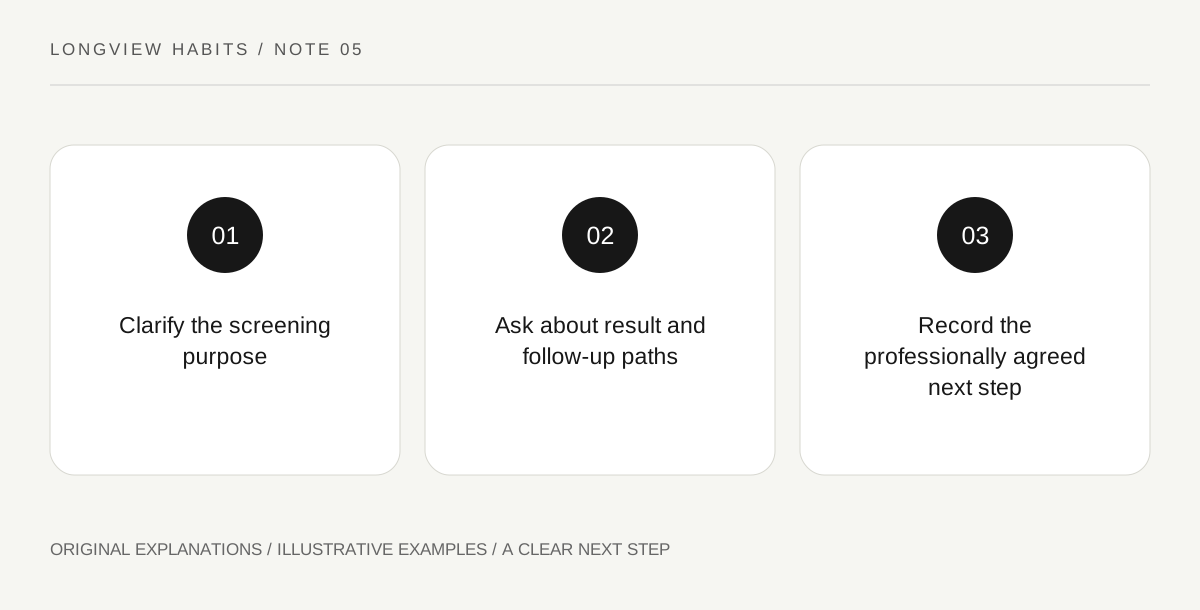
Original explanatory diagram. Read the full method and limitations below.
Identify the stated purpose
MedlinePlus describes screening as checking for disease before symptoms are present and explains that appropriate tests depend on individual factors. Record why the provider has offered this particular test rather than assuming a familiar name means the same purpose in every situation. If you have a new symptom, tell the provider instead of waiting for a routine screening invitation to address it. The worksheet supplies no schedule or judgment about whether a particular test is appropriate for an individual.
Ask what happens after each possible result
Prepare questions about how results are communicated and what kinds of follow-up may be discussed. Do not invent probabilities or assume that an abnormal screening result confirms a disease. Likewise, do not treat a reassuring result as a universal explanation for unrelated symptoms. The useful preparation is understanding the next conversation, not rehearsing a diagnosis. Ask the service what the test can and cannot establish, using its actual patient information rather than an anecdote from someone whose circumstances may differ.
Clarify the practical process without altering instructions
Use the actual provider’s preparation, appointment and accessibility information. If directions conflict or are difficult to follow, contact the service before guessing a substitute. Keep prescribed medicine questions with qualified professionals; do not change treatment because an internet checklist mentions fasting or another preparation. A supporter can help organize transport or reminders with agreement, while the clinical process remains the provider’s. Record practical obstacles early so they can be discussed rather than concealed until the appointment.
Keep a decision note proportional to the discussion
After the professional conversation, write the agreed next step and any question still open. Separate that from the test result when it later arrives. The aim is informed participation, not proving diligence by accepting every possible test or avoiding every test out of fear. A bounded question sheet can make preventive care more understandable while keeping symptoms, diagnosis and screening in their proper relationships. It supports healthy aging through clearer communication without promising that one test can certify a future free of illness.
Illustrative everyday example
Illustrative question sheet: an adult receives a screening invitation and asks the provider about its purpose, result communication and possible follow-up. A new concern is reported separately rather than assumed to be covered by the invitation. The final note records the professional plan and the service’s actual preparation instructions, with no invented risk percentage or self-directed change to prescribed care.
Questions that come up
Does an abnormal screening result automatically establish a diagnosis?
Do not make that inference. Ask the responsible clinician what the result means and what additional assessment, if any, is appropriate.
Can a screening schedule replace a discussion of a new symptom?
No. Tell the appropriate provider about a new concern rather than assuming a routine preventive process will address it.
References and scope
These sources support the factual background. Examples and exercises are original illustrative teaching material. References do not imply endorsement.
- MedlinePlus: Health Screening — Screening before symptoms and the dependence of appropriate tests on personal factors; no individualized test recommendation or schedule.