After a health visit: give each unresolved action a responsible contact
A visit can end with several instructions that sound clear in the room but become difficult to coordinate at home. Turn the written information into a short action record without rewriting the clinical plan. The useful questions are what is actually requested, who is responsible and how an unclear or missing instruction will be resolved.
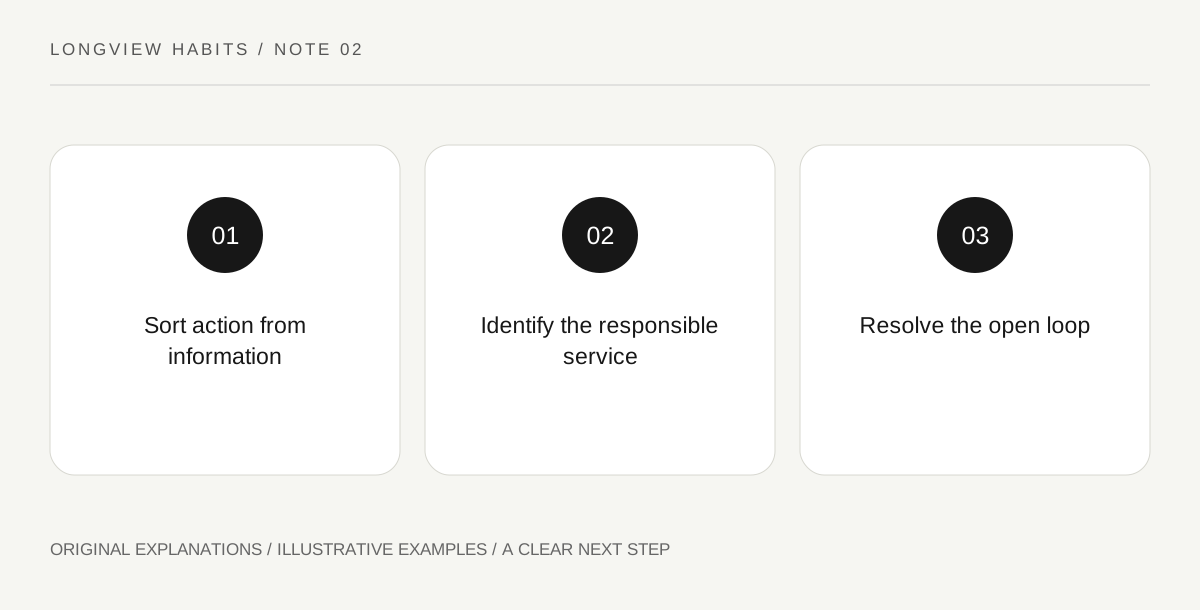
Original explanatory diagram. Read the full method and limitations below.
Preserve the original instructions
NIA encourages asking questions when medical terms or instructions are unclear and clarifying how test results will be received. Begin with the clinic’s actual written summary and keep it intact. A personal worksheet is an organizing aid, not a replacement prescription or an amended medical record. If the spoken discussion and written information appear inconsistent, contact the provider through its stated process. Do not choose the version that seems more convenient or ask an unqualified helper to settle the discrepancy.
Separate action, information and question
Create three headings. Under action, copy the task in the provider’s own terms or reference the original instruction. Under information, note material supplied for reading. Under question, record anything that remains unclear. This prevents an educational leaflet from becoming an assumed order and stops an unresolved question from masquerading as a confirmed next step. Keep medicine dosing and preparation directions on the authoritative document rather than condensing them into shorthand that could lose an important condition.
Attach the responsible service
For each action, identify the service that should arrange or answer it according to the clinic’s instructions. A test order, a referral and a follow-up appointment may involve different contacts. Record the actual contact route and any timing the provider supplied; invent no universal deadline. If nobody is clearly responsible, make that the first clarification question. A supporter may help make an authorized call, but the record should preserve who the patient wants involved and which information may be shared.
Close the loop without assuming silence means completion
When a result or booking is expected, follow the process agreed with the provider. If the expected communication does not arrive, use the stated contact route rather than assuming everything is normal. Do not delay a new or concerning health issue while trying to finish administrative steps; seek appropriate care for the situation. The record succeeds when it makes unresolved actions visible and directs them to the responsible service, leaving clinical interpretation and changes to qualified professionals.
Illustrative everyday example
Illustrative record: a patient leaves with a referral and an expected test-result message. The referral is listed as an action with the named service; a leaflet goes under information. An unclear phrase about preparation stays under question until the clinic answers. When the expected message is missing, the patient uses the agreed contact process instead of interpreting silence as a reassuring result.
Questions that come up
Can I simplify a medicine instruction into my own shorthand?
Avoid replacing the authoritative directions with an abbreviated version that may lose meaning. Ask the clinic or pharmacist to clarify the actual instruction.
Does no message mean a result is normal?
Do not make that assumption. Use the provider’s stated results process and contact route when expected communication is missing.
References and scope
These sources support the factual background. Examples and exercises are original illustrative teaching material. References do not imply endorsement.
- NIA: What Should I Ask My Doctor During a Checkup? — Asking about unclear instructions, medical tests and how results will be communicated; the action-record structure is original.