After retirement: name the role you miss before filling the calendar
An empty work slot does not always mean the same thing as a missing sense of purpose. After retirement or another role change, identify what the former role actually provided before adding commitments. The exercise is a personal planning tool, with no demand to remain productive every hour and no promise that a busy schedule prevents illness or reverses aging.
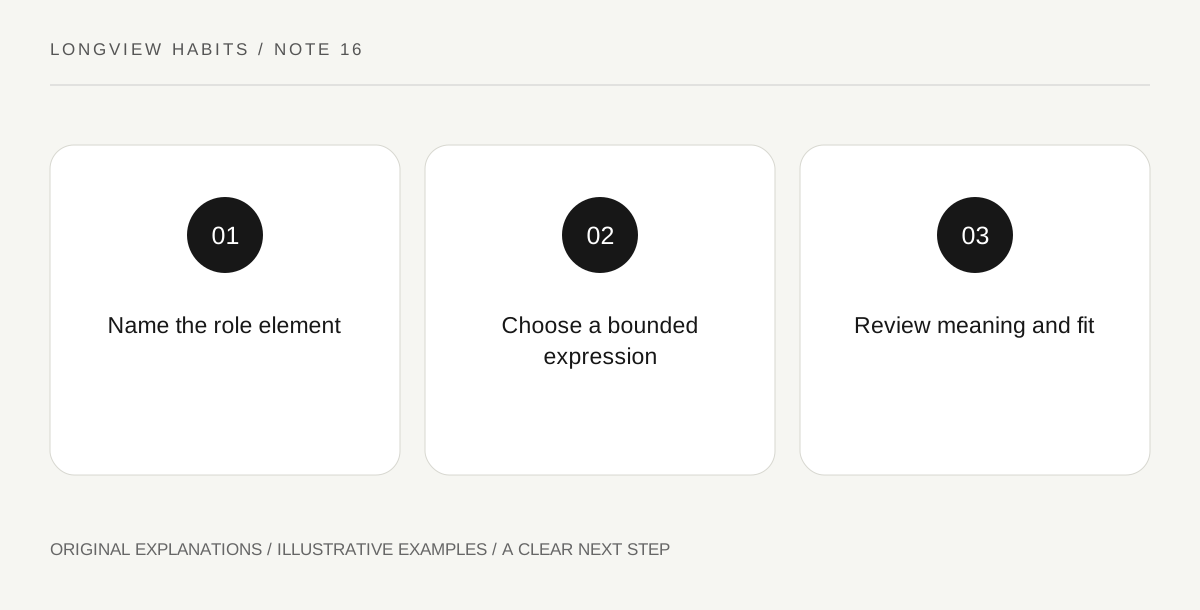
Original explanatory diagram. Read the full method and limitations below.
Separate the timetable from the role
NIA’s activities guidance recognizes personally meaningful activities as part of later-life well-being. Use that broad context without adopting a compulsory model of active aging. Write what you miss in concrete terms: explaining a task, finishing something with others, solving a small problem or another actual part of the role. Keep the person’s own words. Someone who misses teaching colleagues may not want a large social group, and someone relieved to leave work may not want any replacement role immediately.
Choose one function to carry forward
Pick a single role element that still matters, then list two possible ways to express it on a modest scale. These are options, not a new work contract. Check whether each option depends on an institution’s actual availability, training or assistance arrangements. Do not assume that past expertise gives automatic authority in a new setting. A familiar skill can be valuable while the new role still needs boundaries, supervision or a different way of communicating.
Make the commitment easy to review
If an option is chosen, agree its actual scope and a point for discussing how it fits. Leave room to stop or change it without calling the attempt a failure. Avoid accepting a large ongoing responsibility merely because free time exists on paper. Health, caregiving, transport and personal preference still matter. A small role can be meaningful even if it occurs irregularly, and rest does not need to be earned by completing a quota of productive hours.
Evaluate meaning rather than a packed diary
After trying the arrangement, ask whether it included the role element you wanted. Did you actually explain, create, help or learn in the way that mattered, or did administration consume the experience? Keep that answer separate from a medical outcome. The worksheet cannot establish an effect on longevity or cognition. Its practical value is a clearer fit between a changing life and a chosen activity, with enough flexibility to respect the person rather than turning retirement into another performance target.
Illustrative everyday example
Illustrative choice: a retired technician misses explaining problems to colleagues, not the commute or full schedule. They consider a short supervised workshop role and an informal project with a friend. One limited option is agreed and later reviewed for whether explanation was actually part of it. The person makes no new commitment solely to fill hours and draws no health conclusion from enjoying the session.
Questions that come up
Must retirement reproduce the structure of paid work?
No. The planning question is what the person values now. Rest, different interests and no immediate replacement role are legitimate preferences.
Does one meaningful activity prove a health benefit?
No. The exercise evaluates fit and experience. It supplies no individual disease-prevention or longevity claim.
References and scope
These sources support the factual background. Examples and exercises are original illustrative teaching material. References do not imply endorsement.
- NIA: Participating in Activities You Enjoy As You Age — Meaningful chosen activities in later life; no individual medical, longevity or productivity requirement.