A lab report flag: keep the result, unit and reference range together
A colored flag beside a laboratory result can feel like a complete judgment about health. Keep the result attached to its unit, reference range and clinical context before drawing conclusions. The useful task is to prepare a precise question for the ordering clinician, not to turn a report into a biological-age score or an instruction to start supplements.
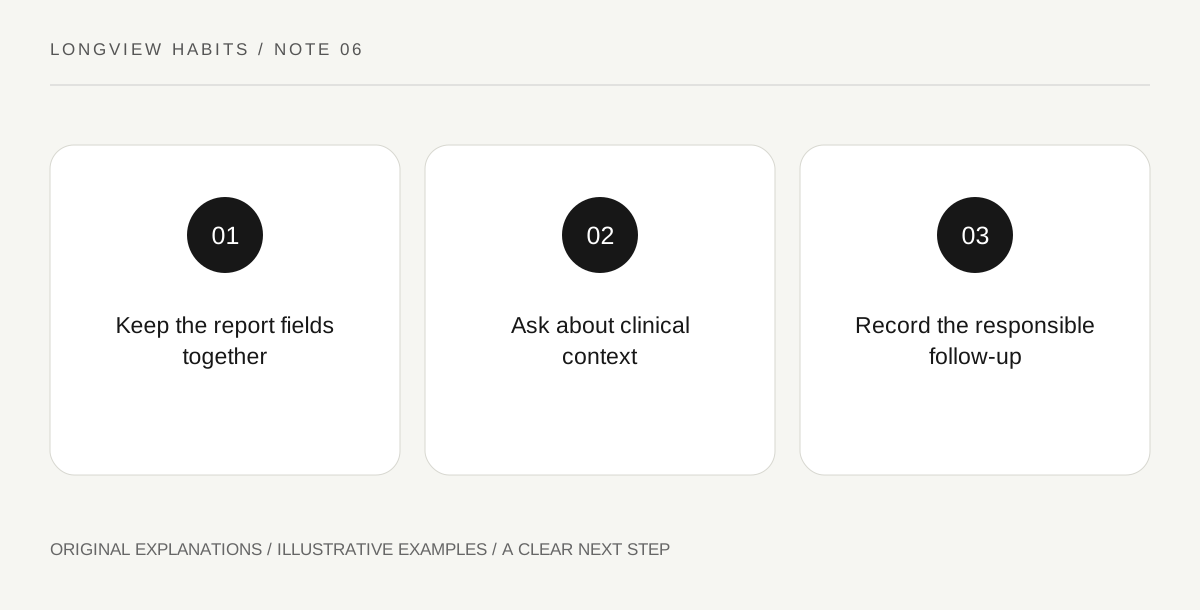
Original explanatory diagram. Read the full method and limitations below.
Read the report as a set of linked fields
MedlinePlus explains that reference ranges can differ among laboratories, that results outside a range are not automatically signs of disease and that results within range do not guarantee good health. Those limits make context essential. Record the test’s actual name, collection date, result, unit and the range printed on that report. Preserve the original document. Do not detach a number into a text message where the unit and laboratory context disappear.
Avoid an internet range substitution
If another website gives a different range, do not replace the report’s range with the one that seems more reassuring or more alarming. Ask the ordering service about the actual result. A number can look similar across reports while the method, unit or relevant context differs. This worksheet supplies no conversion, threshold or personal interpretation. Its purpose is to keep the evidence complete enough for a qualified conversation rather than collect competing normal values until one confirms a preferred conclusion.
Prepare the question around the clinical purpose
Ask why the test was ordered, how the result fits the rest of the assessment and what follow-up is actually recommended. Tell the clinician about relevant preparation or collection circumstances through its normal process without assuming they explain the result. Do not change medicines, add supplements or repeat testing independently to make a flag disappear. If you have a new or concerning symptom, seek appropriate care rather than waiting to assemble a perfect spreadsheet of results.
Keep trends separate from a personal verdict
When discussing earlier results, bring the original reports with dates and context instead of ranking numbers from memory. Let the clinician decide what comparison is meaningful. End your note with the agreed action or clarification, not a self-assigned healthy, unhealthy or younger label. A report can be an important part of care while remaining only one part of the picture. Preserving that distinction makes health information more usable without turning ordinary laboratory variation into a daily performance contest.
Illustrative everyday example
Illustrative record: an adult saves a flagged result with its collection date, unit and printed range. A different online range is placed under questions rather than used to relabel the result. At the follow-up, the ordering clinician explains the result in context and supplies the next step. The adult starts no supplement and draws no conclusion about biological age from the flag alone.
Questions that come up
Does an unflagged result certify overall good health?
No. The cited explanation warns that a value within range does not necessarily exclude a health problem. The result needs clinical context.
Should a flag be corrected with a supplement immediately?
This article provides no such instruction. Ask the qualified professional who can interpret the actual test and your circumstances.
References and scope
These sources support the factual background. Examples and exercises are original illustrative teaching material. References do not imply endorsement.
- MedlinePlus: How to Understand Your Lab Results — Reference-range variability and the limits of inside/outside-range interpretation; no personal threshold, diagnosis or treatment.