A later-life learning project: define one finished artifact instead of a brain score
Learning can be worthwhile because you want to do something new, without needing a claim that the activity makes the brain younger. Define one small finished artifact and choose a learning format that supports it. The goal is a usable skill or enjoyable experience, with progress judged against the chosen task rather than an age comparison or disease-prevention promise.
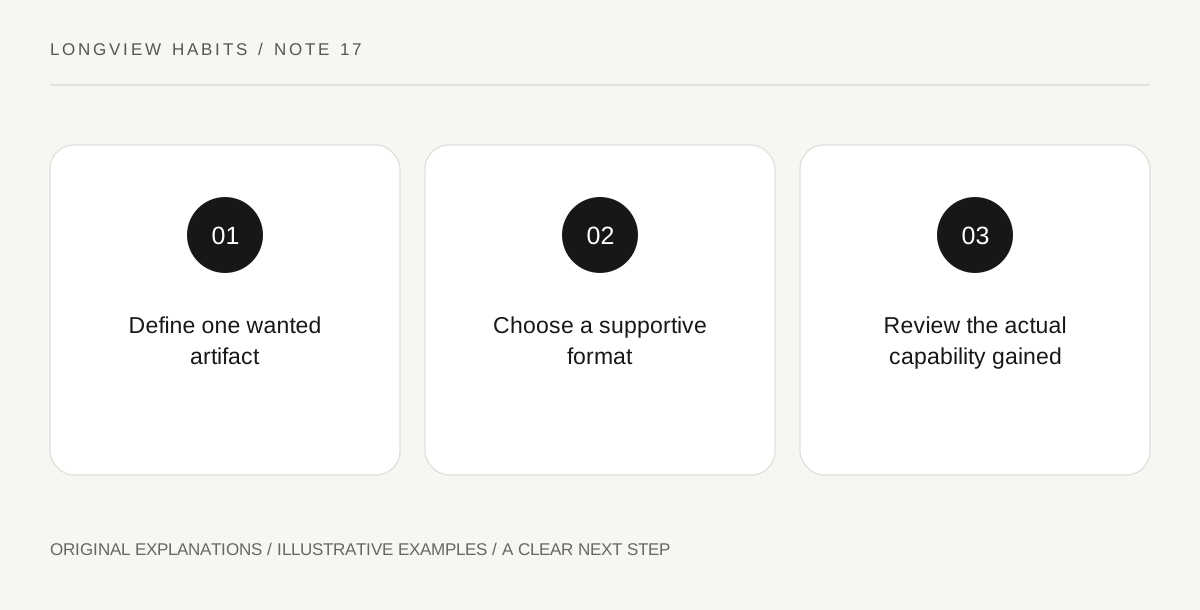
Original explanatory diagram. Read the full method and limitations below.
Choose the task in ordinary terms
NIA includes hobbies and learning-oriented activities among ways people can participate in meaningful later-life activity. That is a reason to consider an interest, not proof that any particular course prevents cognitive decline. Write a concrete outcome such as preparing one labeled family photograph or making a short personal recording. Keep private information under the owner’s control. The artifact should be something the person actually wants, rather than a demonstration selected by someone else to test whether they are keeping up.
Ask how the teaching format handles questions
Before enrolling, ask about pace, materials, accessibility and opportunities to repeat a step. A course title alone does not reveal whether its format suits the learner. Share relevant access needs through the provider’s normal process without assuming that an age label answers them. Decide whether individual help, written instructions or a small group would be useful. These are service preferences, not evidence of a cognitive condition or a reason to infantilize an adult learner.
Break the artifact into observable parts
List the few components needed to finish the chosen item. For a labeled photograph, those might be selecting an appropriate image, writing an accurate caption and saving the result in the agreed place. This is an illustrative project structure, not software instructions. Use current teaching for any actual tool. Keep the components small enough to discuss with the instructor, and allow a different route when a step creates an access barrier. Completion need not mean doing every technical action without any assistance.
Review what can now be done
Compare the result with the original goal. Ask which part the learner understands, what remains confusing and whether they want another project. Do not turn enjoyment or a faster task into a medical conclusion. A meaningful artifact can be valuable even if it required help and even if the person decides not to continue. The outcome is a specific new capability or experience, with the learner’s agency preserved, rather than another number advertised as a measure of biological youth.
Illustrative everyday example
Illustrative project: an adult wants one correctly captioned family photograph for a private album. The learning provider confirms a pace and instruction format that fit. The learner selects the image and writes the caption, receiving agreed help with saving. The review concerns the finished artifact and remaining questions. Nobody interprets the result as a dementia test or claims the course reduced the person’s biological age.
Questions that come up
Does needing help make the project unsuccessful?
No. An agreed support arrangement can be part of a usable learning process. The goal and the learner’s preferences determine what success means.
Can this project be used as a cognitive test?
No. It is an educational activity, not a validated assessment or proof of disease prevention. Health concerns need appropriate professional attention.
References and scope
These sources support the factual background. Examples and exercises are original illustrative teaching material. References do not imply endorsement.
- NIA: Participating in Activities You Enjoy As You Age — Hobbies and personally meaningful activities as options in later life; no cognitive-test, prevention or rejuvenation claim.