A daily drink routine: check access and instructions before setting a target
A reminder to drink can miss the practical reason a beverage is difficult to obtain or use. Review access, the container and any personal clinical instructions before inventing a daily target. The aim is a usable arrangement for an ordinary day, with no universal fluid amount, hydration diagnosis or instruction to override a restriction supplied by a health professional.
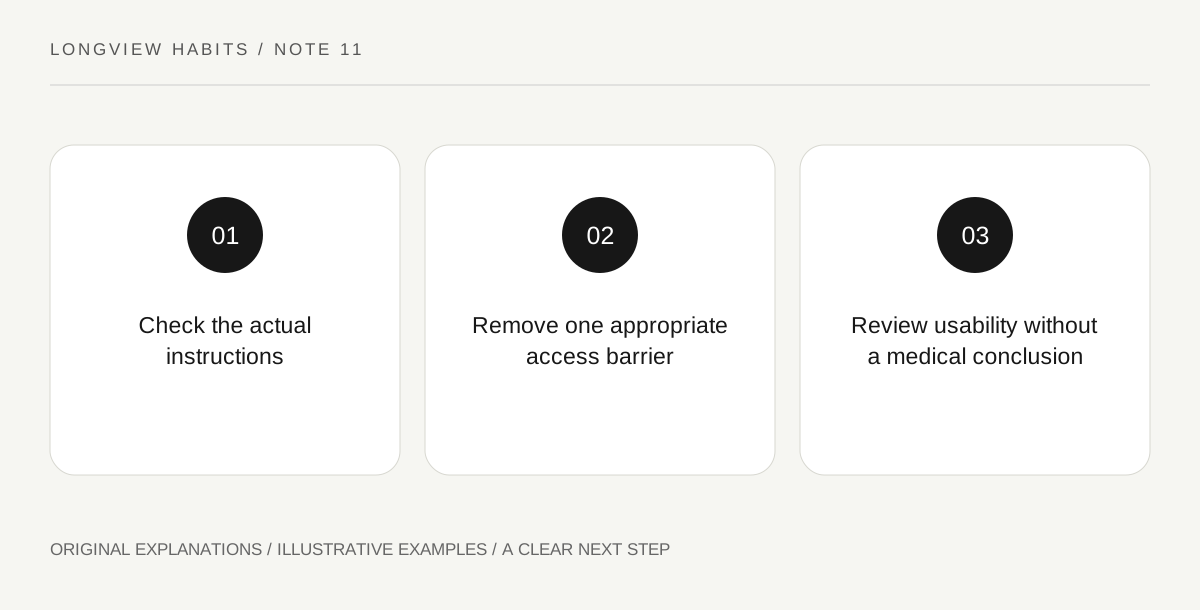
Original explanatory diagram. Read the full method and limitations below.
Start with the instructions that actually apply
NIA’s older-adult nutrition guidance includes hydration among everyday considerations. This broad advice does not replace individualized instructions about fluids or swallowing. If you have such instructions, keep them available and ask the responsible professional about uncertainty. This article does not select a beverage, amount, thickness or timing for a medical condition. A practical review should begin with the person’s actual care context rather than a number repeated online as if every adult’s circumstances were identical.
Identify the obstacle at one ordinary moment
Choose a situation such as preparing a drink at home or taking a permitted beverage to an appointment. Ask whether the obstacle is obtaining it, opening it, carrying it or remembering where it was put. Describe one concrete barrier rather than judging the person as unmotivated. Do not test an unsafe carry or swallowing task to complete the worksheet. A concern about physical ability belongs with appropriate assessment; a missing clean familiar cup may simply need household coordination.
Make the arrangement easy to understand
With the person’s agreement, identify who prepares the permitted drink, where the appropriate container belongs and how it remains identifiable. Avoid moving it to a place that interferes with access or contradicts professional advice. If a container is difficult to handle, ask the relevant professional about suitable options rather than assuming a marketed assistive cup is appropriate. The goal is a clear arrangement, not a competition to achieve the largest bottle size or an app’s generic daily streak.
Review function without turning it into diagnosis
Ask whether the new arrangement reduced the practical obstacle. Do not infer hydration status from a completed checklist or use the article to explain symptoms. Seek appropriate clinical help for a concern, and do not delay that contact while collecting drink records. A useful note can say the container is now reachable and the instructions are understood. That is a meaningful everyday improvement without claiming a medical outcome or treating a simplified routine as proof that all fluid-related needs have been met.
Illustrative everyday example
Illustrative arrangement: an adult already has individualized fluid instructions. They notice that the approved familiar cup is often stored on a difficult shelf, so the household agrees an appropriate reachable location. A separate handling concern is taken to the relevant professional. The notebook records improved access, not a new fluid target, and no one treats the cup’s empty appearance as a clinical assessment.
Questions that come up
Does this article recommend a universal daily amount?
No. It supplies no personal fluid target. Existing clinical instructions and appropriate professional advice take priority.
Does finishing a bottle prove a health concern is resolved?
No. A completed routine is not a clinical assessment. Ask an appropriate professional about symptoms or uncertainty.
References and scope
These sources support the factual background. Examples and exercises are original illustrative teaching material. References do not imply endorsement.
- NIA: Healthy Meal Planning, Tips for Older Adults — Hydration as a general older-adult nutrition consideration; no quantity, restriction change, swallowing technique or diagnostic claim.